

Pages are the building blocks of a report. Depending on the page type, a page can contain narrative, a generated table or graph, component details, or other automatically generated content. Chapters and appendices group related pages and organize them in the table of contents.
Make page changes in a non-active testing variant until you are ready to test the complete report. See Work safely with template variants.
Add a page
- Open Report Templates and select the variant you want to edit
- Add a new page and give it a Title
- Choose a Page Type (the default is Standalone)
- Configure the page settings described below
- Enter content in the editor when the page type allows it
Choose a page type
The page type controls how Reserve Sense creates the page and where its content comes from.
Use Standalone when you want to write and arrange the page content yourself. Choose a specialized page type, such as Cover, Graph, or Table, when Reserve Sense should generate the page from report data or a preset layout.
Configure the page
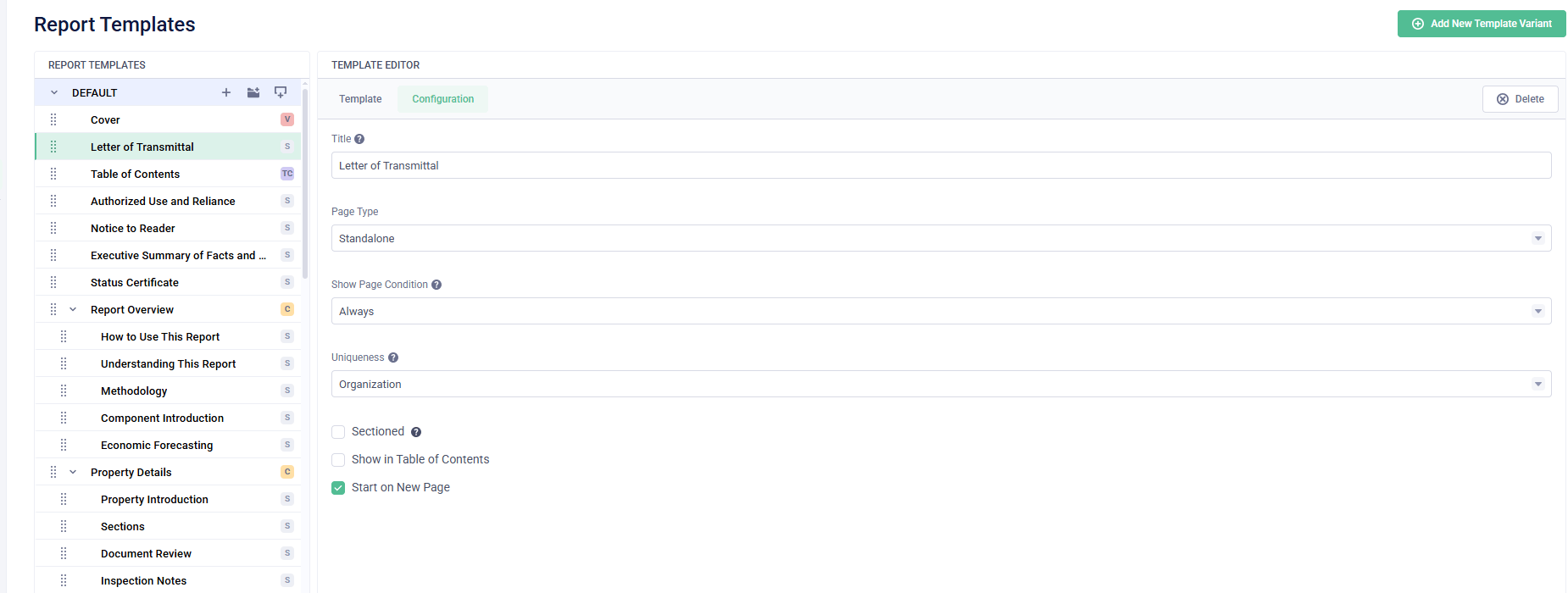
The Configuration tab controls when the page appears, whether it can be customized for one report, and how it fits into the finished PDF.Title
The name of the page as it appears in the template list and, when enabled, in the table of contents.Show Page Condition
This setting controls whether the page appears in a given report. Always includes it in every report; the other options limit when it appears. For example, a CUSPAP appendix can use the option “If at least one signatory has ‘AIC’ certification.” If no AIC member is involved, the appendix stays out of the report. You can select more than one condition. The setting uses OR logic: the page appears when any selected condition is met. The available options are listed below for reference.
To change wording inside a page, use conditionals instead.
Uniqueness
Use Organization when variables and conditionals can supply the property-specific details. Choose Report only when the writer needs to add or revise content for each report. This keeps manual report work focused on pages that genuinely need it.
Sectioned
When enabled, Reserve Sense generates a separate version of the page for every property section. This is intended for British Columbia stratas with legally distinct sections. You might use it for Reserve Fund History or another analysis that needs separate content for each section. Most pages should leave this unchecked. See Sectioned reports.Show in Table of Contents
When enabled, and when a Table of Contents page uses the Report subtype, the page is listed if it appears in the report. This setting is enabled by default on new template items. Turn it off for items such as a cover or Letter of Transmittal that should not appear in the contents. Chapters and appendices also have a Show in Table of Contents setting. Turning it off on a chapter or appendix hides the whole group, including its pages, from the Report table of contents.Start on New Page
Available on Standalone pages. It forces the content to begin on a new PDF page. When disabled, the content continues on the previous PDF page when the preceding item supports a shared page.A Cover page cannot be placed inside a chapter or appendix. A Table of Contents page with Table of Contents Type set to Report must also stay at the top level; a nested Table of Contents can only use Components.
Write page content
Standalone pages have familiar text-editing tools, similar to a word processor. The Reserve Sense menu can insert variables, conditionals, and the editor tools used for links, images, tables, charts, and signatures. Specialized page types use their own settings to generate some or all of their content.Example: Letter of Transmittal
A typical Letter of Transmittal setup:
In the editor, you can use a two-column layout with the property name on the left and the date on the right, followed by the letter body. Add a Signatures block for the assigned signatories.
Because Uniqueness is set to Organization, variables supply the report-specific details without requiring the writer to rewrite the letter for each report.
Next: Organize pages with chapters and appendices →